NORCET Nursing Officer Exam Preparation Guide
The NORCET (Nursing Officer Recruitment Common Eligibility Test) is one of the most competitive nursing recruitment examinations for candidates aspiring to secure a Nursing Officer position in leading healthcare institutions. Every year, thousands of nursing professionals search for reliable information on the NORCET syllabus, effective NORCET preparation strategies, and high-quality Nursing Officer study material to improve their chances of success. Whether you are looking for NORCET nursing questions, NORCET MCQ practice, detailed NORCET nursing notes, or comprehensive NORCET mock test resources, having a structured study plan is essential. This complete guide covers everything you need to know about the Nursing Officer exam, including important topics, exam-focused preparation tips, NORCET previous year questions, and expert-recommended NORCET nursing practice questions. If you are preparing for Nursing Officer recruitment, this resource will help you strengthen your nursing concepts, improve clinical decision-making skills, and build the confidence required to perform well in the NORCET examination.
NORCET Nursing Officer MCQs
Question 1
A nurse notices that a patient’s respiratory rate has increased from 18 to 32 breaths/minute and oxygen saturation has dropped to 89%. What should the nurse do first?
A. Document findings
B. Increase oral fluids
C. Assess airway and breathing
D. Inform family members
Correct Answer:
✅ C. Assess airway and breathing
Detailed Explanation:
The nurse should immediately assess the patient using the ABC (Airway, Breathing, Circulation) approach. A respiratory rate of 32 breaths/minute combined with oxygen saturation of 89% indicates respiratory compromise requiring urgent assessment.
Question 2
Which patient should the nurse assess first?
A. Patient with temperature 37.8°C
B. Patient requesting pain medication
C. Patient with sudden chest pain
D. Patient awaiting discharge
Correct Answer:
✅ C. Patient with sudden chest pain
Detailed Explanation:
Sudden chest pain may indicate myocardial infarction or pulmonary embolism. This situation is potentially life-threatening and takes priority over non-urgent concerns.
Question 3
Which medication is considered a high-alert medication?
A. Paracetamol
B. Insulin
C. Vitamin C
D. Antacid
Correct Answer:
✅ B. Insulin
Detailed Explanation:
Insulin is classified as a high-alert medication because dosing errors can result in severe hypoglycemia or hyperglycemia.
Question 4
The most effective measure to prevent healthcare-associated infections is:
A. Wearing gloves
B. Isolation rooms
C. Hand hygiene
D. Antibiotic therapy
Correct Answer:
✅ C. Hand hygiene
Detailed Explanation:
Hand hygiene remains the single most effective method of preventing transmission of microorganisms in healthcare settings.
Question 5
A patient receiving blood transfusion develops chills and fever. What is the nurse’s first action?
A. Slow the transfusion
B. Stop the transfusion immediately
C. Give paracetamol
D. Document findings
Correct Answer:
✅ B. Stop the transfusion immediately
Detailed Explanation:
Fever and chills may indicate a transfusion reaction. The transfusion must be stopped immediately and institutional protocols followed.
Question 6
A patient with diabetes has blood glucose of 48 mg/dL and is conscious. What should be administered first?
A. Insulin
B. Fast-acting carbohydrate
C. IV potassium
D. Antibiotics
Correct Answer:
✅ B. Fast-acting carbohydrate
Detailed Explanation:
Conscious patients experiencing hypoglycemia should receive glucose or another fast-acting carbohydrate source.
Question 7
Which electrolyte imbalance is most commonly associated with cardiac arrhythmias?
A. Hypernatremia
B. Hypokalemia
C. Hypercalcemia
D. Hypermagnesemia
Correct Answer:
✅ B. Hypokalemia
Detailed Explanation:
Low potassium levels affect cardiac conduction and increase the risk of arrhythmias.
Question 8
The best site for intramuscular injection in adults is:
A. Abdomen
B. Deltoid muscle
C. Dorsogluteal muscle
D. Ventrogluteal muscle
Correct Answer:
✅ D. Ventrogluteal muscle
Detailed Explanation:
The ventrogluteal site has fewer nerves and blood vessels and is considered one of the safest IM injection sites.
Question 9
Which symptom is most suggestive of stroke?
A. Bilateral leg swelling
B. Sudden unilateral weakness
C. Constipation
D. Fever
Correct Answer:
✅ B. Sudden unilateral weakness
Detailed Explanation:
Sudden weakness affecting one side of the body is a classic sign of stroke requiring urgent intervention.
Question 10
What is the normal adult oxygen saturation level?
A. 70–80%
B. 80–85%
C. 95–100%
D. 88–90%
Correct Answer:
✅ C. 95–100%
Detailed Explanation:
Normal oxygen saturation in healthy adults typically ranges between 95% and 100%.
Question 11
A nurse discovers a medication error before administration. What should be done?
A. Administer anyway
B. Correct the error before administration
C. Ignore the mistake
D. Ask another patient
Correct Answer:
✅ B. Correct the error before administration
Detailed Explanation:
Patient safety is the priority. The medication should be rechecked and corrected before administration.
Question 12
The Glasgow Coma Scale assesses:
A. Kidney function
B. Cardiac function
C. Level of consciousness
D. Liver function
Correct Answer:
✅ C. Level of consciousness
Detailed Explanation:
GCS evaluates eye opening, verbal response, and motor response to assess neurological status.
Question 13
Which nursing intervention helps prevent pressure ulcers?
A. Restrict mobility
B. Reposition every 2 hours
C. Increase sedation
D. Limit fluids
Correct Answer:
✅ B. Reposition every 2 hours
Detailed Explanation:
Regular repositioning reduces pressure and improves tissue perfusion.
Question 14
Which vital sign finding requires immediate reporting?
A. HR 78 bpm
B. BP 118/76 mmHg
C. RR 8 breaths/min
D. Temperature 37°C
Correct Answer:
✅ C. RR 8 breaths/min
Detailed Explanation:
Respiratory depression can rapidly become life-threatening.
Question 15
Which infection requires airborne precautions?
A. MRSA
B. Tuberculosis
C. Hepatitis B
D. UTI
Correct Answer:
✅ B. Tuberculosis
Detailed Explanation:
TB spreads through airborne droplets and requires specialized isolation measures.
Question 16
A patient with heart failure develops increasing shortness of breath and crackles in both lungs. Which intervention should the nurse perform first?
A. Encourage fluids
B. Position patient upright
C. Administer laxatives
D. Restrict oxygen
✅ Answer: B. Position patient upright
Detailed Explanation:
The upright position reduces venous return and improves lung expansion, helping relieve pulmonary congestion.
Question 17
Which assessment finding is most indicative of left-sided heart failure?
A. Peripheral edema
B. Ascites
C. Pulmonary crackles
D. Hepatomegaly
✅ Answer: C. Pulmonary crackles
Detailed Explanation:
Left-sided heart failure causes fluid accumulation in the lungs, producing crackles and dyspnea.
Question 18
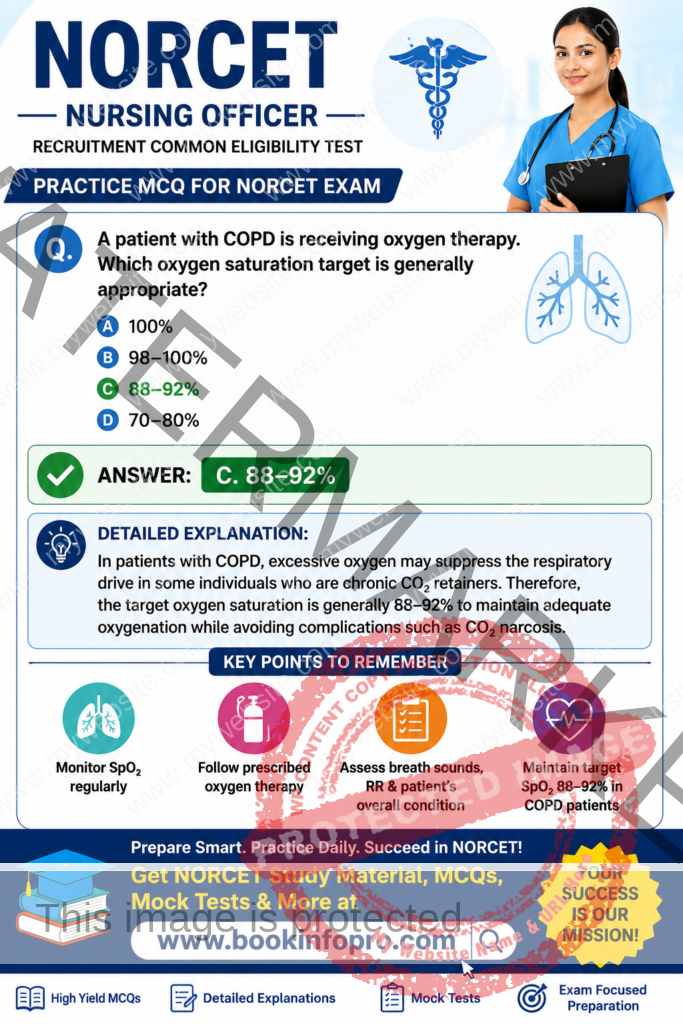
A patient with COPD is receiving oxygen therapy. Which oxygen saturation target is generally appropriate?
A. 100%
B. 98-100%
C. 88-92%
D. 70-80%
✅ Answer: C. 88-92%
Detailed Explanation:
Excessive oxygen may suppress respiratory drive in some COPD patients. Target saturation is usually 88-92%.
Question 19
Which symptom is a classic sign of hypokalemia?
A. Muscle weakness
B. Hypertension
C. Hyperactivity
D. Flushed skin
✅ Answer: A. Muscle weakness
Detailed Explanation:
Low potassium levels commonly cause muscle weakness, fatigue, and cardiac arrhythmias.
Question 20
A nurse is caring for a patient with sepsis. Which finding requires immediate escalation?
A. Temperature 38°C
B. Heart rate 90 bpm
C. Blood pressure 82/48 mmHg
D. Mild headache
✅ Answer: C. Blood pressure 82/48 mmHg
Detailed Explanation:
Hypotension is a sign of septic shock and requires urgent intervention.
Question 21
Which medication is commonly used to treat anaphylaxis?
A. Furosemide
B. Epinephrine
C. Aspirin
D. Metformin
✅ Answer: B. Epinephrine
Detailed Explanation:
Epinephrine is the first-line treatment for anaphylactic reactions.
Question 22
The priority nursing intervention for a patient having a tonic-clonic seizure is:
A. Insert oral airway
B. Restrain limbs
C. Protect from injury
D. Offer water
✅ Answer: C. Protect from injury
Detailed Explanation:
Safety is the priority during a seizure. Restraints should never be used.
Question 23
Which laboratory value confirms hypoglycemia?
A. Blood glucose 52 mg/dL
B. Blood glucose 140 mg/dL
C. Blood glucose 180 mg/dL
D. Blood glucose 220 mg/dL
✅ Answer: A. Blood glucose 52 mg/dL
Detailed Explanation:
A blood glucose level below 70 mg/dL is considered hypoglycemia.
Question 24
A patient receiving warfarin requires monitoring of:
A. INR
B. Troponin
C. HbA1c
D. Creatinine
✅ Answer: A. INR
Detailed Explanation:
INR monitoring helps assess anticoagulation effectiveness and bleeding risk.
Question 25
Which nursing action reduces the risk of catheter-associated urinary tract infection?
A. Daily catheter irrigation
B. Maintain closed drainage system
C. Disconnect tubing frequently
D. Elevate drainage bag above bladder
✅ Answer: B. Maintain closed drainage system
Detailed Explanation:
Maintaining a sterile, closed drainage system significantly reduces infection risk.
Question 26
A patient suddenly becomes confused and restless after surgery. What should the nurse assess first?
A. Airway and oxygenation
B. Hair color
C. Meal preferences
D. Family history
✅ Answer: A. Airway and oxygenation
Detailed Explanation:
Hypoxia is a common cause of sudden confusion and requires immediate assessment.
Question 27
Which electrolyte is most important for cardiac muscle contraction?
A. Sodium
B. Potassium
C. Calcium
D. Chloride
✅ Answer: C. Calcium
Detailed Explanation:
Calcium plays a vital role in cardiac and skeletal muscle contraction.
Question 28
Which patient is at greatest risk for pressure ulcers?
A. Ambulatory patient
B. Bedridden patient
C. Patient with mild headache
D. Healthy adolescent
✅ Answer: B. Bedridden patient
Detailed Explanation:
Immobility is a major risk factor for pressure ulcer development.
Question 29
The most important intervention to prevent falls is:
A. Keep bed in lowest position
B. Increase room temperature
C. Restrict fluids
D. Close curtains permanently
✅ Answer: A. Keep bed in lowest position
Detailed Explanation:
Keeping the bed low improves patient safety and reduces fall risk.
Question 30
A patient with chest pain receives nitroglycerin. Which assessment is essential?
A. Blood pressure
B. Hair texture
C. Appetite
D. Vision
✅ Answer: A. Blood pressure
Detailed Explanation:
Nitroglycerin may cause significant hypotension.
Question 31
Which vaccine is typically administered shortly after birth?
A. BCG
B. Influenza
C. HPV
D. Hepatitis A
✅ Answer: A. BCG
Detailed Explanation:
BCG helps protect against severe forms of tuberculosis.
Question 32
The first step in the nursing process is:
A. Planning
B. Assessment
C. Evaluation
D. Implementation
✅ Answer: B. Assessment
Detailed Explanation:
Assessment provides data necessary for all subsequent nursing actions.
Question 33
A nurse notices redness over a patient’s sacrum that does not blanch. This indicates:
A. Stage 1 pressure injury
B. Stage 2 pressure injury
C. Stage 3 pressure injury
D. Stage 4 pressure injury
✅ Answer: A. Stage 1 pressure injury
Detailed Explanation:
Non-blanchable redness is the hallmark of Stage 1 pressure injury.
Question 34
Which symptom is common in hyperglycemia?
A. Polyuria
B. Bradycardia
C. Hypothermia
D. Constipation
✅ Answer: A. Polyuria
Detailed Explanation:
Elevated blood glucose causes osmotic diuresis resulting in frequent urination.
Question 35
Which finding suggests fluid overload?
A. Weight loss
B. Dry mucous membranes
C. Crackles in lungs
D. Decreased edema
✅ Answer: C. Crackles in lungs
Detailed Explanation:
Fluid accumulation in the lungs commonly causes crackles.
Question 36
A patient expresses suicidal thoughts. What is the nurse’s priority?
A. Ensure patient safety
B. Leave patient alone
C. Ignore statement
D. Discuss diet
✅ Answer: A. Ensure patient safety
Detailed Explanation:
Suicide risk requires immediate assessment and safety precautions.
Question 37
Which condition requires droplet precautions?
A. Tuberculosis
B. Influenza
C. MRSA wound infection
D. Scabies
✅ Answer: B. Influenza
Detailed Explanation:
Influenza spreads through respiratory droplets.
Question 38
The most accurate indicator of fluid balance is:
A. Daily weight
B. Appetite
C. Mood
D. Temperature
✅ Answer: A. Daily weight
Detailed Explanation:
Daily weight reflects fluid gain or loss accurately.
Question 39
A postpartum woman develops heavy vaginal bleeding. The nurse should suspect:
A. Hemorrhage
B. Migraine
C. Constipation
D. Asthma
✅ Answer: A. Hemorrhage
Detailed Explanation:
Postpartum hemorrhage is a life-threatening emergency.
Question 40
Which medication classification relieves pain and inflammation?
A. NSAIDs
B. Antibiotics
C. Antifungals
D. Antivirals
✅ Answer: A. NSAIDs
Detailed Explanation:
NSAIDs provide analgesic and anti-inflammatory effects.
Question 41
A patient with AKI is at risk for:
A. Hyperkalemia
B. Hypoglycemia
C. Hyperthermia
D. Leukopenia
✅ Answer: A. Hyperkalemia
Detailed Explanation:
Impaired renal excretion can lead to elevated potassium levels.
Question 42
Which nursing action prevents aspiration?
A. Elevate head of bed
B. Place patient flat
C. Restrict breathing exercises
D. Remove oxygen
✅ Answer: A. Elevate head of bed
Detailed Explanation:
Elevating the head reduces aspiration risk during feeding.
Question 43
A patient complains of calf pain and swelling. The nurse should suspect:
A. DVT
B. Migraine
C. UTI
D. Pneumonia
✅ Answer: A. DVT
Detailed Explanation:
Calf pain and swelling are classic signs of deep vein thrombosis.
Question 44
Which assessment finding indicates worsening asthma?
A. Wheezing
B. Silent chest
C. Mild cough
D. Sneezing
✅ Answer: B. Silent chest
Detailed Explanation:
A silent chest indicates severe airway obstruction and impending respiratory failure.
Question 45
The antidote for opioid overdose is:
A. Naloxone
B. Vitamin K
C. Atropine
D. Insulin
✅ Answer: A. Naloxone
Detailed Explanation:
Naloxone rapidly reverses opioid-induced respiratory depression.
Question 46
Which patient should be seen first?
A. Patient with SpO₂ 84%
B. Patient requesting blanket
C. Patient asking for water
D. Patient awaiting discharge
✅ Answer: A. Patient with SpO₂ 84%
Detailed Explanation:
Severe hypoxemia is immediately life-threatening.
Question 47
Which nutrient is essential for wound healing?
A. Protein
B. Alcohol
C. Caffeine
D. Sodium only
✅ Answer: A. Protein
Detailed Explanation:
Protein supports tissue repair and collagen formation.
Question 48
Which assessment finding suggests meningitis?
A. Neck stiffness
B. Hair loss
C. Constipation
D. Polyuria
✅ Answer: A. Neck stiffness
Detailed Explanation:
Nuchal rigidity is a classic sign of meningitis.
Question 49
A nurse discovers a patient is allergic to a prescribed medication. What should be done?
A. Hold medication and notify provider
B. Administer half dose
C. Give medication quickly
D. Ignore allergy
✅ Answer: A. Hold medication and notify provider
Detailed Explanation:
Administering a known allergen can result in severe adverse reactions.
Question 50
Which nursing principle is most important when delegating tasks?
A. Delegate without supervision
B. Match task to competency
C. Delegate all assessments
D. Avoid communication
✅ Answer: B. Match task to competency
Detailed Explanation:
Safe delegation requires assigning tasks according to the individual’s training, competence, and scope of practice.