Applied Microbiology Important Questions for BSc Nursing Students
Complete Unit-Wise Important Questions, Viva Questions, and Exam Preparation Guide
Applied Microbiology is one of the most important subjects in the BSc Nursing curriculum. It provides nursing students with essential knowledge about microorganisms, infectious diseases, immunity, sterilization, disinfection, infection prevention, and laboratory diagnostic procedures. Understanding microbiology helps nurses prevent infections, maintain patient safety, and deliver quality healthcare services.
This collection of Applied Microbiology Important Questions is designed to help BSc Nursing students prepare effectively for university examinations, internal assessments, practical examinations, viva voce, and competitive nursing examinations. The content covers important theory questions, frequently repeated university questions, short notes, long essays, and quick revision topics.
What is Applied Microbiology?
Applied Microbiology is the branch of microbiology that focuses on the practical applications of microorganisms in healthcare, medicine, nursing, disease diagnosis, infection prevention, and public health.
The subject helps students understand:
- Bacteria
- Viruses
- Fungi
- Protozoa
- Parasites
- Immunity
- Vaccination
- Sterilization
- Disinfection
- Hospital infection control
Microbiology knowledge enables nurses to recognize infectious diseases, implement infection control measures, educate patients, and participate in disease prevention programs.
Importance of Applied Microbiology in Nursing
Applied Microbiology plays a vital role in modern nursing practice.
Importance includes:
- Prevention of healthcare-associated infections
- Safe patient care
- Proper specimen collection
- Understanding disease transmission
- Effective infection control
- Biomedical waste management
- Vaccination and immunization programs
- Antibiotic stewardship
- Patient education
- Community health promotion
Nurses use microbiological principles daily in hospitals, clinics, community settings, and public health programs.
Learning Objectives
After studying Applied Microbiology, nursing students should be able to:
- Explain microbiological concepts
- Identify major microorganisms
- Understand disease-causing pathogens
- Apply infection prevention measures
- Describe immunity and immunization
- Understand sterilization procedures
- Interpret laboratory investigations
- Prevent healthcare-associated infections
- Educate patients regarding infectious diseases
- Implement standard precautions in clinical practice
Unit 1: Introduction to Microbiology
Very Short Questions
- Define microbiology.
- Define pathogen.
- Define infection.
- What is a microorganism?
- Define contamination.
- Define normal flora.
- Define communicable disease.
- Define opportunistic infection.
- Who is the father of microbiology?
- Who proposed germ theory?
Short Questions
- Scope of microbiology.
- Contributions of Louis Pasteur.
- Contributions of Robert Koch.
- Koch’s postulates.
- Importance of microbiology in nursing.
- Classification of microorganisms.
- Role of microbiology in healthcare.
- History of microbiology.
Long Essay Questions
- Explain the development of microbiology.
- Discuss the importance of microbiology in nursing practice.
- Describe Koch’s postulates with examples.
- Explain the contributions of Louis Pasteur to microbiology.
Unit 2: Bacteriology
Very Short Questions
- Define bacteria.
- Name different bacterial shapes.
- Define capsule.
- Define spore.
- Define plasmid.
- What is bacterial flagella?
- Define bacterial cell wall.
- What is binary fission?
- Define culture media.
- Define colony.
Short Questions
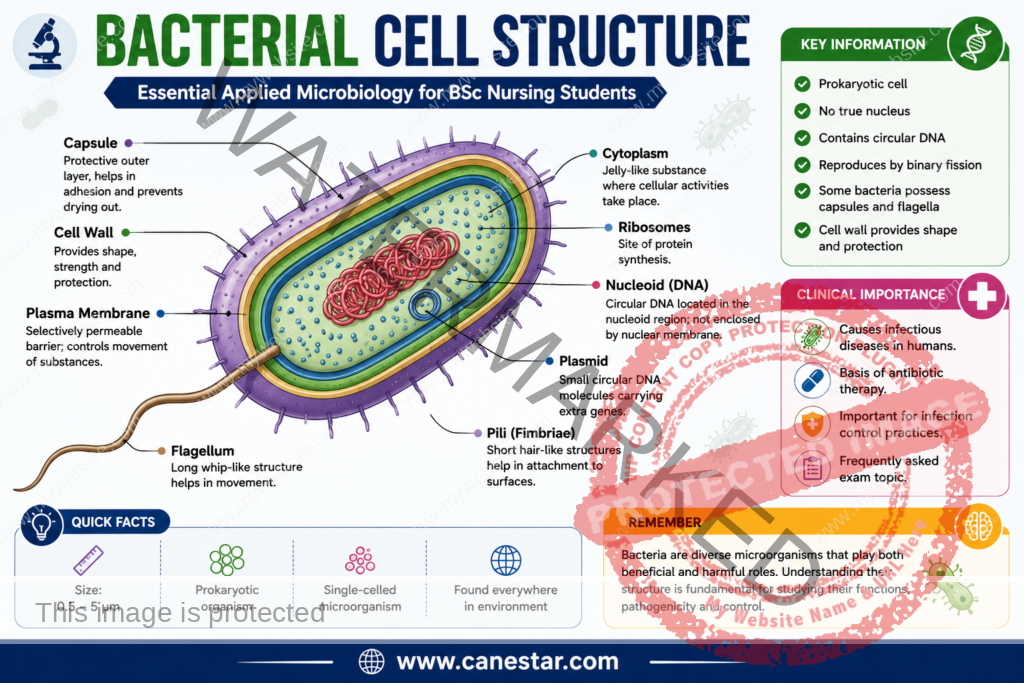
- Structure of bacterial cell.
- Bacterial growth curve.
- Types of culture media.
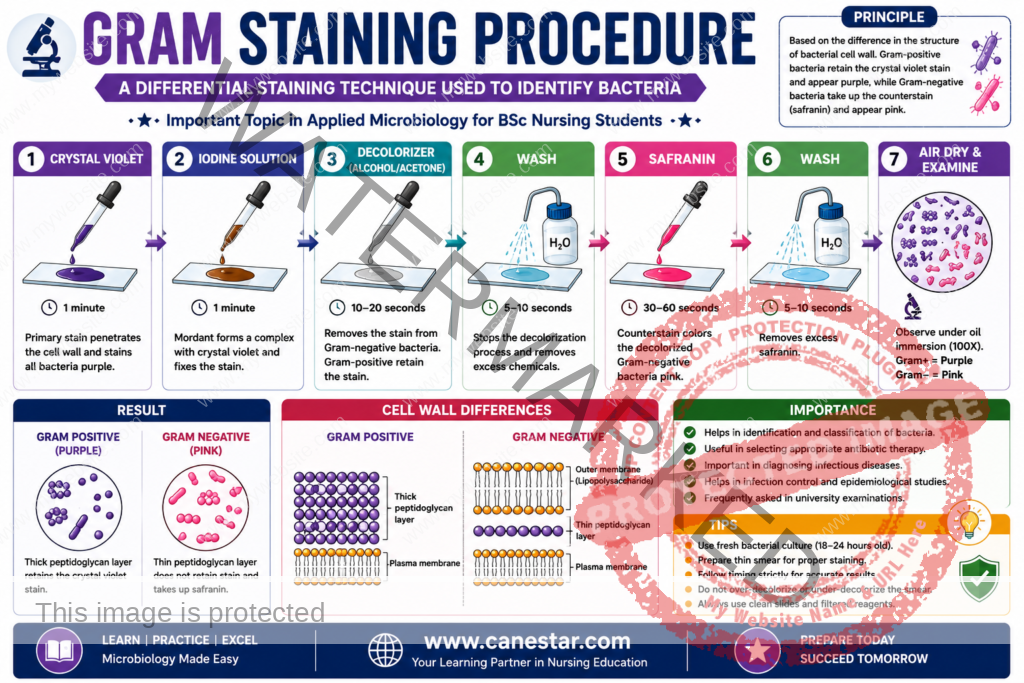
- Gram staining.
- Acid-fast staining.
- Capsule staining.
- Bacterial reproduction.
- Classification of bacteria.
- Sterilization of culture media.
- Anaerobic bacteria.
Long Essay Questions
- Describe the structure of a bacterial cell with diagram.
- Explain Gram staining procedure and significance.
- Discuss bacterial growth curve.
- Explain classification of culture media.
Unit 3: Sterilization and Disinfection
Very Short Questions
- Define sterilization.
- Define disinfection.
- Define antiseptic.
- Define asepsis.
- Define pasteurization.
- What is autoclaving?
- Define fumigation.
- Define nosocomial infection.
- Define biomedical waste.
- Define hand hygiene.
Short Questions
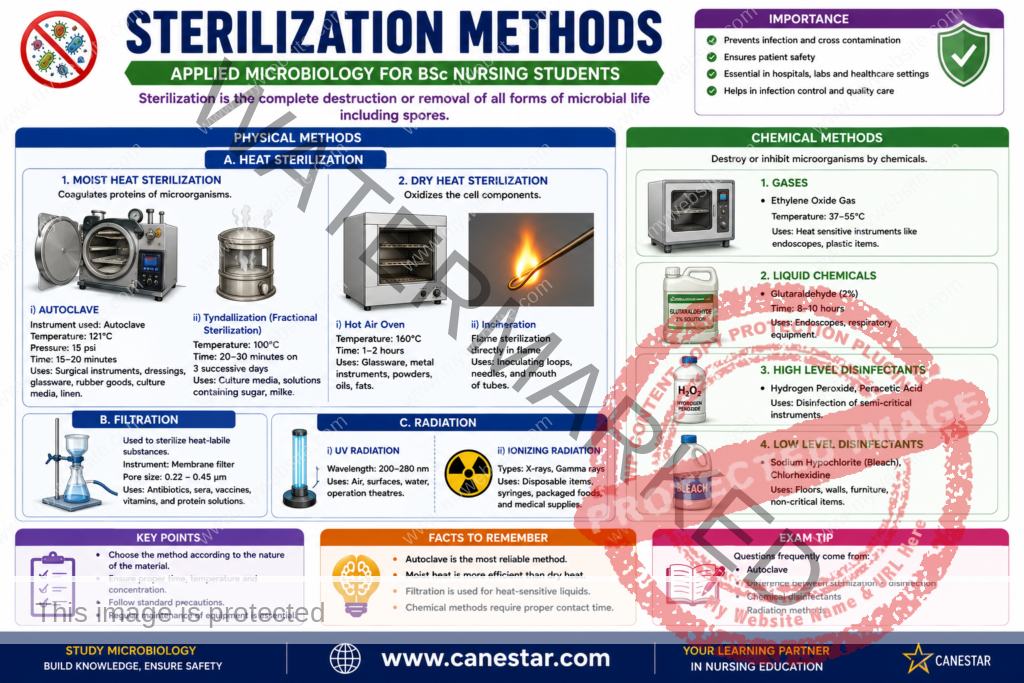
- Moist heat sterilization.
- Dry heat sterilization.
- Autoclave.
- Hot air oven.
- Chemical disinfectants.
- Standard precautions.
- Biomedical waste management.
- Hospital-acquired infection prevention.
- Personal protective equipment.
- Handwashing technique.
Long Essay Questions
- Explain sterilization methods used in hospitals.
- Discuss biomedical waste management.
- Explain infection control measures in healthcare settings.
- Describe autoclave and its principles.
Unit 4: Immunology
Very Short Questions
- Define immunity.
- Define antigen.
- Define antibody.
- What is vaccination?
- Define immunization.
- What is active immunity?
- What is passive immunity?
- Define hypersensitivity.
- Define allergy.
- What is herd immunity?
Short Questions
- Types of immunity.
- Antigen-antibody reaction.
- Immunoglobulins.
- Vaccines.
- Vaccination schedule.
- Hypersensitivity reactions.
- Autoimmune diseases.
- Cold chain maintenance.
- Immunization programs.
- Universal Immunization Programme.
Long Essay Questions
- Explain immunity and its types.
- Discuss antigen-antibody reactions.
- Describe immunization and vaccination.
- Explain the role of vaccines in disease prevention.
Unit 5: Virology
Very Short Questions
- Define virus.
- What is HIV?
- What is Hepatitis B virus?
- What is influenza virus?
- Define viral infection.
- What is rabies virus?
- Define COVID-19.
- Define viral replication.
- What is poliovirus?
- Define antiviral drugs.
Short Questions
- Structure of virus.
- HIV infection.
- Hepatitis B.
- Rabies.
- Influenza.
- COVID-19.
- Viral transmission.
- Viral diagnosis.
- Vaccines against viral diseases.
- Prevention of viral infections.
Long Essay Questions
- Explain HIV infection and nursing management.
- Discuss Hepatitis B infection.
- Explain structure and replication of viruses.
- Describe prevention and control of viral diseases.
Unit 6: Mycology
Important Questions
Short Notes
- Candida albicans
- Dermatophytes
- Aspergillosis
- Ringworm infection
- Opportunistic fungal infections
Long Questions
- Explain fungal infections and nursing management.
- Describe common pathogenic fungi affecting humans.
Unit 7: Parasitology
Important Questions
Short Notes
- Entamoeba histolytica
- Plasmodium species
- Giardia lamblia
- Hookworm infestation
- Ascariasis
Long Questions
- Explain malaria and its prevention.
- Discuss amoebiasis and nursing care.
- Describe common intestinal parasites.
Frequently Asked Viva Questions
- What is Gram staining?
- What is sterilization?
- What is disinfection?
- What is an antigen?
- What is an antibody?
- What is immunity?
- What is HIV?
- What is Hepatitis B?
- What is an autoclave?
- What is biomedical waste?
- What is a pathogen?
- What is normal flora?
- What is asepsis?
- What is nosocomial infection?
- What is vaccination?
Most Frequently Repeated University Questions
The following questions are commonly asked in nursing examinations:
- Structure of bacterial cell.
- Gram staining procedure.
- Autoclave.
- Sterilization methods.
- Hospital-acquired infections.
- Biomedical waste management.
- HIV infection.
- Tuberculosis.
- Types of immunity.
- Antigen-antibody reaction.
- Vaccination and immunization.
- Culture media.
- Bacterial growth curve.
- Hepatitis B infection.
- Universal Immunization Programme.
Students should prioritize these topics during revision.
Tips to Score High in Applied Microbiology
Learn Definitions Thoroughly
Most short-answer questions are based on definitions and terminology.
Practice Diagrams
Important diagrams include:
- Bacterial cell structure
- Virus structure
- HIV structure
- Autoclave
- Antigen-antibody reaction
Study Previous Year Questions
Repeated questions often appear in university examinations.
Revise Daily
Regular revision improves retention and confidence.
Practice MCQs
MCQs help reinforce concepts and improve examination performance.
Clinical Applications of Microbiology in Nursing
Nurses apply microbiology knowledge in:
- Infection prevention
- Isolation precautions
- Sterile procedures
- Catheter care
- Wound management
- Immunization services
- Laboratory specimen collection
- Biomedical waste disposal
- Community health programs
- Outbreak management
Understanding microbiology enhances patient safety and healthcare quality.
Career Importance of Applied Microbiology
Microbiology knowledge is valuable in:
- Medical wards
- Surgical wards
- Intensive Care Units
- Operation theatres
- Emergency departments
- Dialysis units
- Infection control units
- Community health centers
- Public health organizations
- Research institutions
Frequently Asked Questions (FAQs)
What is Applied Microbiology?
Applied Microbiology is the study of microorganisms and their practical applications in healthcare, disease prevention, diagnosis, and patient management.
Why is microbiology important for nursing students?
Microbiology helps nursing students understand infections, immunity, sterilization, infection control, and patient safety practices.
What are the most important microbiology topics for exams?
Bacterial cell structure, Gram staining, sterilization methods, HIV, tuberculosis, immunity, vaccines, biomedical waste management, and infection control.
Is Applied Microbiology difficult?
No. With proper understanding of concepts, diagrams, and regular revision, students can perform well in examinations.
Are these questions useful for BSc Nursing examinations?
Yes. These questions are based on common syllabus topics and frequently repeated university examination patterns.
Download Applied Microbiology Important Questions PDF
These Applied Microbiology Important Questions for BSc Nursing Students provide a comprehensive collection of theory questions, short notes, viva questions, repeated university questions, and revision topics. They are designed to help nursing students improve understanding, strengthen examination preparation, and build confidence in microbiology concepts.
Master Applied Microbiology, improve your exam performance, and strengthen your nursing knowledge with these carefully selected important questions and study resources.
APPLIED MICROBIOLOGY
IMPORTANT QUESTIONS
FOR BSC NURSING 2024
FOR FREE APPLIED MICROBIOLOGY SHORT NOTES CLICK HERE
FREE INFECTION CONTROL AND SAFETY NOTES FOR BSC NURSING SECOND YEAR THIRD SEMESTER CLICK HERE
APPLIED MICROBIOLOGY MCQS WITH ANSWER
Which of the following microorganisms is responsible for most urinary tract infections (UTIs)? a. Escherichia coli
b. Staphylococcus aureus
c. Streptococcus pneumoniae
d. Mycobacterium tuberculosis
Answer: a. Escherichia coli
A nurse is caring for a patient with a wound infection. The wound appears red, swollen, and warm. This clinical presentation is indicative of: a. Fungal infection
b. Viral infection
c. Bacterial infection
d. Parasitic infection
Answer: c. Bacterial infection
Which of the following is a common method to prevent the spread of hospital-acquired infections? a. Hand hygiene
b. Avoiding vaccinations
c. Overuse of antibiotics
d. Poor waste management
Answer: a. Hand hygiene
A patient is diagnosed with methicillin-resistant Staphylococcus aureus (MRSA) infection. What precautionary measures should the nurse take? a. Standard precautions
b. Contact precautions
c. Droplet precautions
d. Airborne precautions
Answer: b. Contact precautions
Which of the following is an example of an opportunistic fungal infection often seen in immunocompromised patients? a. Candidiasis
b. Tuberculosis
c. Malaria
d. Toxoplasmosis
Answer: a. Candidiasis
What is the primary mode of transmission for Clostridium difficile infection? a. Airborne
b. Droplet
c. Contact
d. Vehicle (fomite)
Answer: c. Contact
Which of the following immunizations is routinely recommended for healthcare workers to prevent hepatitis B virus (HBV) infection? a. Influenza vaccine
b. Hepatitis A vaccine
c. Measles, mumps, and rubella (MMR) vaccine
d. Hepatitis B vaccine
Answer: d. Hepatitis B vaccine
A nurse is caring for a patient with tuberculosis (TB). Which type of isolation precaution is required for this patient? a. Standard precautions
b. Contact precautions
c. Droplet precautions
d. Airborne precautions
Answer: d. Airborne precautions
The process of destroying or inhibiting the growth of microorganisms on inanimate objects is known as: a. Disinfection
b. Sterilization
c. Antisepsis
d. Sanitization
Answer: a. Disinfection
Which of the following is a viral sexually transmitted infection that can lead to cervical cancer? a. Chlamydia
b. Herpes simplex virus (HSV)
c. Human papillomavirus (HPV)
d. Gonorrhea
Answer: c. Human papillomavirus (HPV)
A nurse is caring for a patient with a suspected viral respiratory infection. What precautionary measures should be implemented? a. Standard precautions
b. Contact precautions
c. Droplet precautions
d. Airborne precautions
Answer: c. Droplet precautions
Which of the following is an example of a vector-borne disease transmitted by ticks? a. Dengue fever
b. Lyme disease
c. Chikungunya
d. Zika virus
Answer: b. Lyme disease
What is the primary mode of transmission for the human immunodeficiency virus (HIV)? a. Airborne
b. Fecal-oral
c. Bloodborne
d. Foodborne
Answer: c. Bloodborne
A patient is diagnosed with a respiratory infection caused by the fungus Aspergillus. What type of infection is this likely to be? a. Bacterial infection
b. Viral infection
c. Fungal infection
d. Parasitic infection
Answer: c. Fungal infection
Which of the following is an example of a Gram-negative bacteria that can cause healthcare-associated infections, particularly in immunocompromised patients? a. Staphylococcus aureus
b. Escherichia coli
c. Streptococcus pneumoniae
d. Clostridium difficile
Answer: b. Escherichia coli