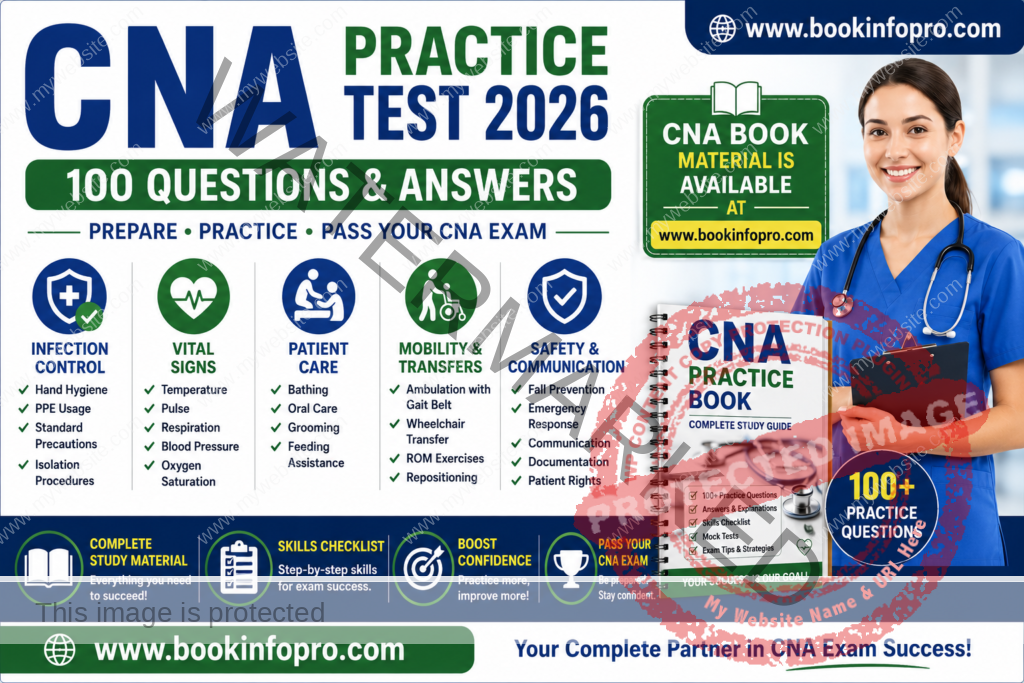
FREE CNA NURSING ASSISTANT PRACTICE HIGH YIELD QUESTIONS WITH ANSWERS
CNA Nursing Assistant MCQ Questions are an essential study resource for students preparing for the Certified Nursing Assistant (CNA) exam. These multiple-choice questions cover key nursing topics such as patient care, infection control, vital signs, communication, safety, and daily living activities. Practicing CNA MCQs helps candidates strengthen their knowledge, improve critical thinking, and gain confidence to pass the CNA certification exam. Whether you are a nursing student, a CNA exam candidate, or looking for practice tests, CNA MCQ questions provide a quick and effective way to prepare for success.
What Is the CNA Exam?
The Certified Nursing Assistant (CNA) exam evaluates a candidate’s ability to provide safe and effective patient care.
Most CNA certification exams contain two parts:
Written Examination
The written portion includes multiple-choice questions covering:
- Infection control
- Patient safety
- Communication
- Resident rights
- Vital signs
- Nutrition and hydration
- Documentation
- Personal care
Skills Examination
The practical exam evaluates skills such as:
- Handwashing
- Measuring pulse
- Measuring respirations
- Blood pressure measurement
- Feeding assistance
- Ambulation using a gait belt
- Transfer techniques
- Bed making
- Range of motion exercises
Both sections must be passed to become a Certified Nursing Assistant.
Why CNA Practice Tests Are Important
Practice tests help students:
Improve Confidence
Repeated exposure to exam-style questions reduces anxiety.
Identify Weak Areas
Students can focus their study efforts more effectively.
Learn Question Patterns
Understanding how questions are asked improves test performance.
Improve Time Management
Practice exams help students complete questions more efficiently.
Increase Passing Scores
Consistent practice improves knowledge retention.
Most Important CNA Exam Topics
Infection Control
Infection control is one of the highest-scoring topics on the CNA exam.
Important concepts include:
- Hand hygiene
- Personal protective equipment (PPE)
- Standard precautions
- Isolation precautions
- Preventing cross-contamination
Patient Safety
Patient safety questions frequently appear on CNA exams.
Key concepts include:
- Fall prevention
- Wheelchair safety
- Bed safety
- Proper body mechanics
- Emergency response
Vital Signs
Candidates should understand:
- Temperature
- Pulse
- Respirations
- Blood pressure
- Oxygen saturation
Normal Adult Vital Signs
- Temperature: 97°F–99°F
- Pulse: 60–100 bpm
- Respirations: 12–20 breaths/min
- Oxygen Saturation: 95%–100%
Communication Skills
CNAs must communicate effectively with residents, families, and healthcare staff.
Communication topics include:
- Active listening
- Respectful communication
- Documentation
- Reporting observations
- Patient confidentiality
Resident Rights
Every CNA should understand:
- Privacy
- Dignity
- Confidentiality
- Right to refuse treatment
- Respect and independence
1. Q1: Which is the normal range for an adult’s oral temperature?
A. 95.0–95.8°F
B. 96.4–98.3°F
C. 97.6–99.6°F
D. 100.2–101.1°F
Correct Answer: C
Explanation: Normal oral temperature is 97.6–99.6°F.
2. Q2: The first step in hand hygiene is
A. Apply soap
B. Adjust water temperature
C. Wet hands
D. Use towel to turn off faucet
Correct Answer: C
Explanation: Hands should be wet first before applying soap.
3. Q3: Which of the following prevents bedsores?
A. Massaging reddened skin
B. Changing position frequently
C. Applying tight bandages
D. Keeping patient immobile
Correct Answer: B
Explanation: Frequent repositioning prevents pressure ulcers.
4. Q4: When assisting a patient with ambulation, the NA should
A. Walk behind the patient
B. Walk on the weaker side
C. Walk on the stronger side
D. Always use a wheelchair
Correct Answer: B
Explanation: Walking on the weaker side provides balance and support.
5. Q5: The best way to identify a patient is by
A. Calling their name
B. Looking at their bed number
C. Checking their wristband
D. Asking another staff
Correct Answer: C
Explanation: Checking ID wristband ensures correct patient.
6. Q6: What is the main purpose of body mechanics?
A. Prevent falls
B. Increase comfort
C. Prevent injury
D. Build muscle strength
Correct Answer: C
Explanation: Proper body mechanics prevent staff and patient injuries.
7. Q7: The medical term for urination is
A. Defecation
B. Micturition
C. Diuresis
D. Continence
Correct Answer: B
Explanation: Micturition means urination.
8. Q8: When feeding a dependent patient, the NA should
A. Stand while feeding
B. Sit at eye level
C. Rush the meal
D. Feed only soft food
Correct Answer: B
Explanation: Sitting at eye level promotes dignity and safety.
9. Q9: What is the best position for a patient with breathing difficulty?
A. Supine
B. Prone
C. Fowler’s
D. Trendelenburg
Correct Answer: C
Explanation: Fowler’s position improves lung expansion.
10. Q10: What is the first action if a patient begins choking?
A. Run for help
B. Perform abdominal thrusts
C. Encourage coughing
D. Hit back hard
Correct Answer: C
Explanation: Encouraging coughing is first if airway is partially blocked.
How to Pass the CNA Exam
Study Daily
Review CNA concepts consistently rather than cramming.
Take Practice Tests
Practice questions help reinforce learning.
Learn the Skills
Do not focus only on the written exam.
Practice:
- Handwashing
- Ambulation
- Transfers
- Feeding assistance
- Vital signs
Review Mistakes
Learn why answers are correct and incorrect.
Focus on Safety
Patient safety is heavily tested on both written and practical exams.
CNA Skills Checklist
Before exam day, ensure you can perform:
✓ Handwashing
✓ PPE Application
✓ Temperature Measurement
✓ Pulse Measurement
✓ Respiratory Rate Measurement
✓ Blood Pressure Measurement
✓ Feeding Assistance
✓ Ambulation with Gait Belt
✓ Transfer to Wheelchair
✓ Bed Making
✓ Denture Care
✓ Catheter Care
✓ Range of Motion Exercises
✓ Positioning Patients
Common CNA Exam Mistakes
Many students lose points because they:
- Forget hand hygiene
- Fail to provide privacy
- Ignore safety precautions
- Rush through procedures
- Miss critical skill steps
- Forget documentation
Avoiding these mistakes can significantly improve your score.
Frequently Asked Questions
Is the CNA exam difficult?
The CNA exam is manageable when students prepare using study guides, practice questions, and skills practice.
How many questions are on the CNA exam?
The number varies by state, but most exams include a written test and a practical skills evaluation.
What should I study most?
Focus on:
- Infection control
- Vital signs
- Patient safety
- Communication
- Resident rights
- Personal care
How long should I study?
Most students benefit from 4–8 weeks of focused preparation.
Get the Complete CNA Practice Book
Looking for more CNA exam preparation materials?
Our CNA Practice Book includes:
✅ 100+ Practice Questions
✅ Detailed Answer Explanations
✅ CNA Skills Checklists
✅ Infection Control Review
✅ Vital Signs Charts
✅ Mock Exams
✅ Exam-Day Strategies
✅ Quick Revision Notes
Visit www.bookinfopro.com for complete CNA study materials and nursing assistant exam preparation resources.
Related Articles
- CNA Skills Checklist PDF
- How to Pass the CNA Skills Exam
- CNA Practice MCQs with Answers
- CNA Vital Signs Study Guide
- CNA Infection Control Questions
- NNAAP Practice Questions and Answers
- CNA Exam Tips for Beginners
- Nursing Assistant Interview Questions