INFECTION CONTROL IMPORTANT QUESTIONS FOR BSC NURSING 2024
Infection Control Important Questions for BSc Nursing Students
Complete Exam Preparation Guide, Viva Questions, Short Notes and Frequently Asked University Questions
Infection control is one of the most important subjects in nursing education. It focuses on preventing the transmission of infectious microorganisms within healthcare settings and protecting patients, healthcare workers, and the community from healthcare-associated infections.
Effective infection control practices reduce morbidity, mortality, hospital stays, treatment costs, and the spread of multidrug-resistant organisms. Every nurse must possess strong knowledge of infection prevention principles, standard precautions, isolation techniques, sterilization methods, and biomedical waste management.
This guide contains important questions, examination topics, viva questions, revision notes, and frequently repeated university questions for BSc Nursing students.
FREE APPLIED MICROBIOLOGY NOTES FOR BSC NURSING SECOND YEAR THIRD SEMESTER CLICK HERE
FREE INFECTION CONTROL AND SAFETY NOTES FOR BSC NURSING SECOND YEAR THIRD SEMESTER CLICK HERE
VERY SHORT ANSWER (2 MARKS)
Infection
Commensals
Normal flora
Resident flora
Normal flora examples
Types of infection
Zoonoses
Vectors
Mechanical vectors
Biological vectors
Vertical transmission
Genital transmission
Chemical disinfection
Sharp decontaminating unit
Autoclave
Incineration
Universal precaution
Care bundles
Types of care bundles
Central line bundles
Severe sepsis bundles
Cheat sheet
CLABSI
Hand hygiene
Use of PPE
Disinfection
Sterilization
Pasteurization
Antisepsis
HEPA filter
Environmental cleaning
MDRO
Surgical safety
Laser safety
Fire safety
Radiation safety
Fire alarms
Types of spill
Vaccination
Needle stick injuries (NSI)
SHORT ANSWER (5 MARKS)
Factors determining the nature of normal flora
Role of normal flora
Types of infection
Sources and reservoirs of infection
Transmission of infection
Categories of biomedical waste
Types of care bundles
CLABSI
Prevention of surgical site infection (SSI)
Infection control committee
Surveillance of HAI
Isolation precautions
PPE
Types of isolation systems
HICPAC isolation precaution
Airborne precautions
Droplet precautions
Contact precautions
Cdc guidelines
Principles of hand hygiene
WHO hand hygiene
Hot air oven
Autoclave
Equipment cleaning
Spaulding’s principle
Specimen collection
Sample transportation
Laundry management
Care of vulnerable patients
Care of patients with tube and attachment
Care of drains
Prevention of IV complications
Prevention of fall
Prevention of DVT
Shifting and transporting of patients
Surgical safety
Prevention of communication errors
Prevention of HAI
Safety protocol
Fire fighting equipment
Types of spill MSDS
Environmental safety
Aspect impact analysis
AUDITS
Emergency codes
Role of nurse in times of disaster
Annual health check
Post exposure prophylaxis
ESSAY (10 MARKS)
Nosocomial infection
Hospital waste management
Hand hygiene
Sterilization
Staff precaution in handling specimens
Antibiotic stewardship
Documentation
CAPA
Report writing
IPSG
Needle stick injuries and post exposure prophylaxis
Occupational health ordinance
What is HAZMAT and explain about types of spill
How to prevent of MRSA, MDRO in healthcare setting
Explain epidemiology and infection prevention according to CDC guidelines
What is Infection Control?
Infection control refers to policies, procedures, and practices designed to prevent or minimize the spread of infectious agents in healthcare environments.
The main objectives are:
- Prevent transmission of infection
- Protect patients and healthcare workers
- Reduce healthcare-associated infections
- Improve patient safety
- Promote quality healthcare services
Importance of Infection Control in Nursing
Infection control is an essential nursing responsibility.
Benefits include:
- Prevention of hospital-acquired infections
- Protection of healthcare personnel
- Reduction of disease transmission
- Improved patient outcomes
- Decreased healthcare costs
- Safe clinical environment
- Prevention of outbreaks
Nurses play a central role in implementing infection prevention strategies during patient care.
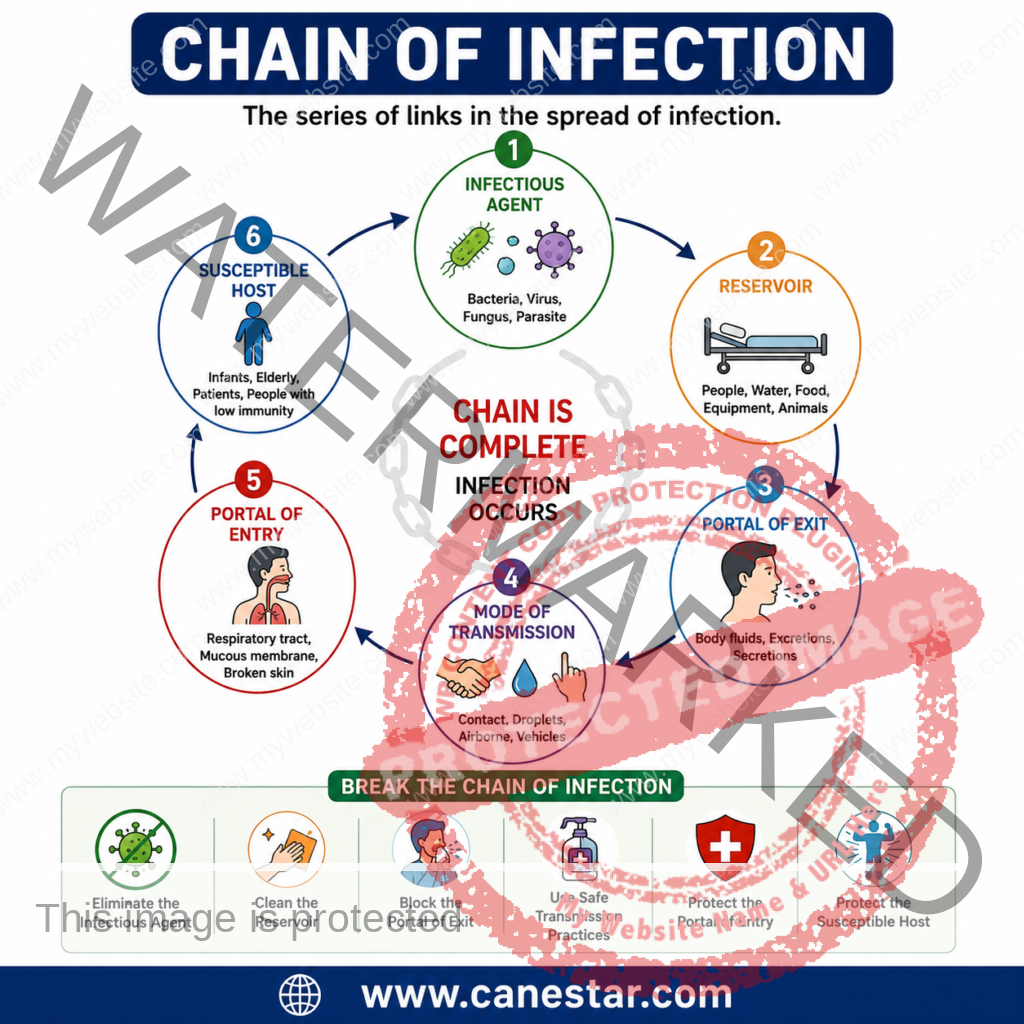
Chain of Infection
Understanding the chain of infection is a common examination topic.
The chain consists of:
- Infectious agent
- Reservoir
- Portal of exit
- Mode of transmission
- Portal of entry
- Susceptible host
Important Question
Explain the chain of infection and methods to break the chain.
Standard Precautions
Standard precautions are infection prevention practices applied to all patients regardless of diagnosis.
They include:
- Hand hygiene
- Personal protective equipment (PPE)
- Respiratory hygiene
- Safe injection practices
- Environmental cleaning
- Waste management
- Safe handling of specimens
Frequently Asked Questions
- Define standard precautions.
- Explain components of standard precautions.
- Describe the importance of standard precautions.
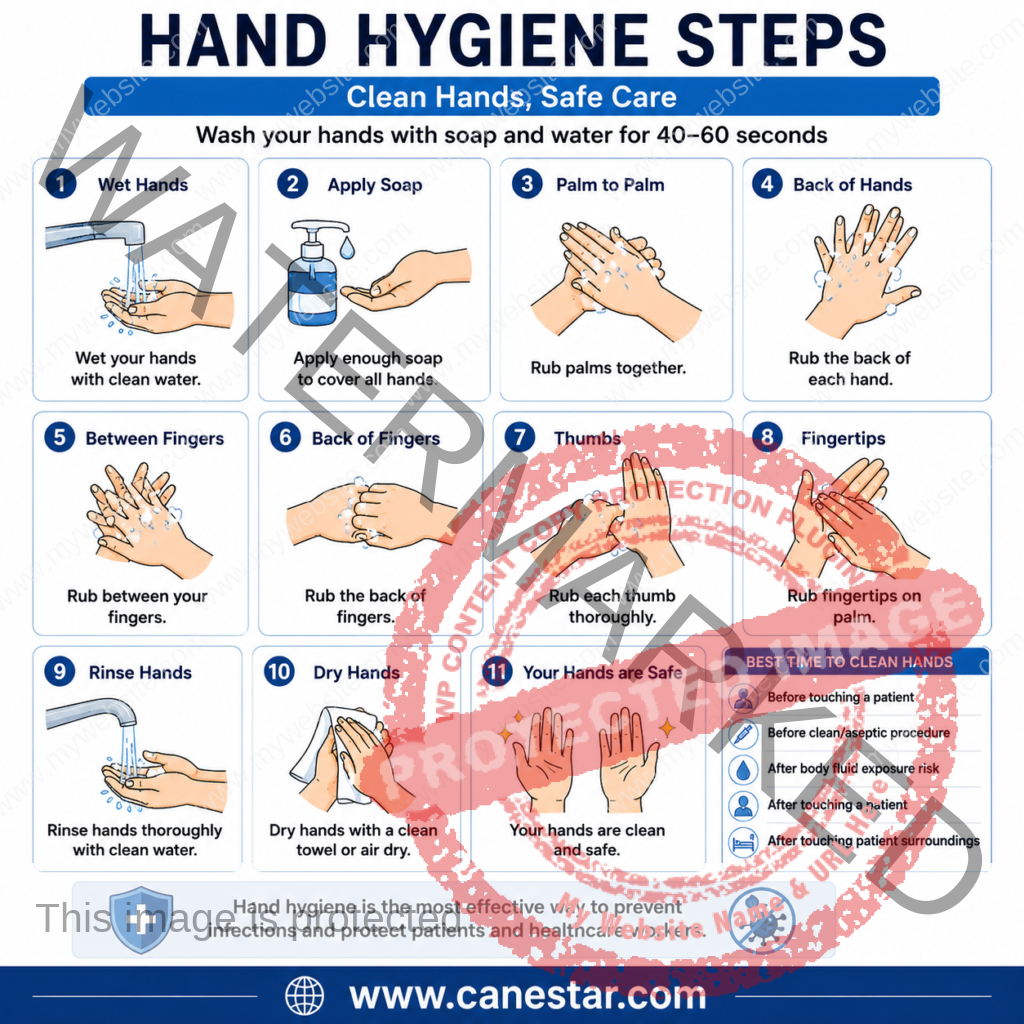
Hand Hygiene
Hand hygiene is considered the most effective infection prevention measure.
Five Moments of Hand Hygiene
- Before touching a patient
- Before a clean procedure
- After body fluid exposure
- After touching a patient
- After touching patient surroundings
Important Examination Questions
- Explain handwashing procedure.
- Discuss WHO five moments of hand hygiene.
- Describe surgical hand scrub.
Personal Protective Equipment (PPE)
PPE protects healthcare workers from exposure to infectious agents.
Types of PPE
- Gloves
- Masks
- N95 respirators
- Gowns
- Face shields
- Goggles
Frequently Asked Questions
- Define PPE.
- Explain donning and doffing procedures.
- Discuss indications for N95 mask use.
Isolation Precautions
Isolation precautions prevent transmission of infectious diseases.
Contact Precautions
Used for:
- MRSA
- VRE
- Wound infections
Droplet Precautions
Used for:
- Influenza
- Meningitis
- Pertussis
Airborne Precautions
Used for:
- Tuberculosis
- Measles
- Chickenpox
Important Question
Differentiate contact, droplet and airborne precautions.
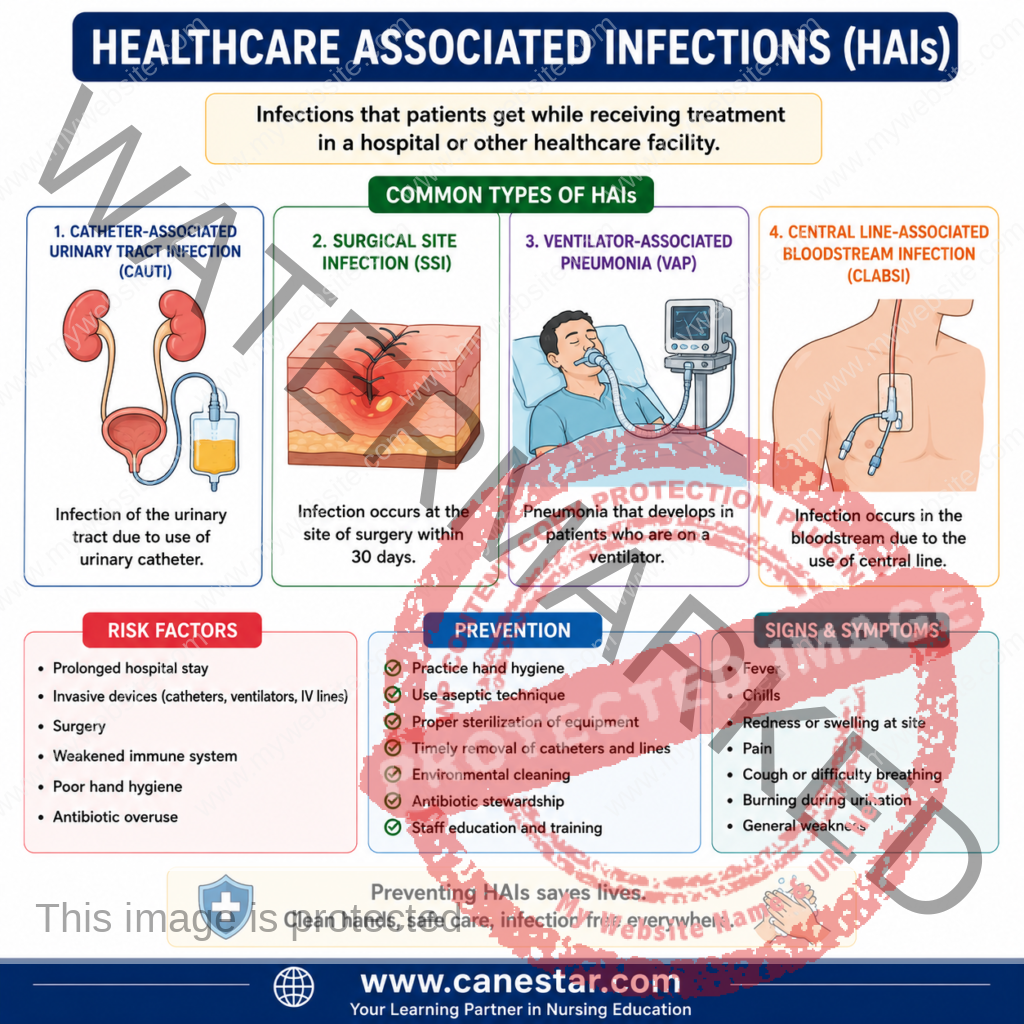
Healthcare-Associated Infections (HAIs)
Healthcare-associated infections occur during healthcare delivery.
Common HAIs
- Catheter-associated urinary tract infection
- Surgical site infection
- Ventilator-associated pneumonia
- Central line-associated bloodstream infection
Important Questions
- Define healthcare-associated infection.
- Discuss causes of HAIs.
- Explain prevention strategies.
Sterilization and Disinfection
Frequently repeated nursing examination topic.
Sterilization
Complete destruction of all microorganisms including spores.
Disinfection
Elimination of pathogenic microorganisms except bacterial spores.
Methods of Sterilization
- Autoclaving
- Dry heat sterilization
- Radiation
- Gas sterilization
Important Questions
- Define sterilization.
- Explain autoclave.
- Differentiate sterilization and disinfection.
- Describe methods of sterilization.
Biomedical Waste Management
Proper waste disposal prevents infection transmission.
Waste Categories
- Yellow
- Red
- White
- Blue
Important Questions
- Explain biomedical waste segregation.
- Discuss color coding of biomedical waste.
- Describe nurse’s role in waste management.
Needle Stick Injury Management
Healthcare workers are at risk of occupational exposure.
Immediate Steps
- Wash with soap and water.
- Report incident immediately.
- Assess exposure risk.
- Follow post-exposure protocol.
Important Questions
- Define needle stick injury.
- Explain management following exposure.
- Discuss post-exposure prophylaxis.
Hospital Infection Control Committee
The infection control committee monitors infection prevention activities within healthcare facilities.
Functions
- Surveillance
- Policy development
- Staff training
- Outbreak investigation
- Audit and monitoring
Frequently Asked Question
Explain the role of Infection Control Committee in hospitals.
Most Repeated Infection Control Questions in University Exams
- Handwashing procedure.
- Chain of infection.
- Standard precautions.
- Isolation precautions.
- Biomedical waste management.
- Sterilization methods.
- Healthcare-associated infections.
- PPE.
- Needle stick injury management.
- Infection control committee.
- Autoclave.
- Disinfection methods.
- Surgical asepsis.
- Medical asepsis.
- Hospital-acquired infections.
Infection Control Viva Questions
- What is infection control?
- Define sterilization.
- Define disinfection.
- What is hand hygiene?
- What is PPE?
- What is an autoclave?
- What is nosocomial infection?
- What is biomedical waste?
- What is airborne transmission?
- What is contact precaution?
- What is droplet precaution?
- What is isolation?
- What is cross infection?
- What is asepsis?
- What is needle stick injury?
Tips to Score High in Infection Control
Learn Definitions
Most short-answer questions come from definitions.
Practice Diagrams
Important diagrams include:
- Chain of infection
- Handwashing steps
- Biomedical waste color coding
- PPE sequence
- Autoclave diagram
Revise Standard Precautions
This topic appears repeatedly in nursing examinations.
Focus on Clinical Applications
Examiners frequently ask practical infection-control scenarios.
Frequently Asked Questions (FAQs)
What is infection control in nursing?
Infection control refers to measures used to prevent and control the spread of infectious diseases in healthcare settings.
Why is hand hygiene important?
Hand hygiene removes microorganisms and is the most effective method for preventing infection transmission.
What are standard precautions?
Standard precautions are infection-prevention practices applied to all patients regardless of diagnosis.
What is the difference between sterilization and disinfection?
Sterilization destroys all microorganisms including spores, whereas disinfection eliminates most pathogenic microorganisms but not necessarily spores.
What are healthcare-associated infections?
Healthcare-associated infections are infections acquired during healthcare delivery in hospitals or other healthcare facilities.