NORCET Nursing Officer Exam: Complete Preparation Guide, Eligibility, Syllabus, MCQs and Career Opportunities
The Nursing Officer Recruitment Common Eligibility Test (NORCET) is one of the most sought-after nursing recruitment examinations in India. Every year, thousands of nursing professionals prepare for this competitive examination to secure Nursing Officer positions in premier healthcare institutions. Success in NORCET requires a strong foundation in nursing concepts, clinical skills, patient care, pharmacology, infection control, and professional nursing practice.
This comprehensive guide covers everything aspiring candidates need to know about NORCET, including eligibility requirements, syllabus, exam pattern, preparation strategies, study resources, and frequently asked questions.
What is NORCET?
NORCET stands for Nursing Officer Recruitment Common Eligibility Test. It is a standardized examination conducted for the recruitment of Nursing Officers in various healthcare institutions.
The examination evaluates a candidate’s nursing knowledge, clinical competency, patient care skills, professional judgment, communication abilities, and understanding of healthcare practices.
NORCET serves as a benchmark assessment for nursing professionals seeking opportunities in advanced clinical environments and healthcare institutions.
Why is NORCET Important for Nursing Professionals?
NORCET offers nursing candidates an opportunity to demonstrate their professional competency through a structured examination process.
Benefits include:
- Career advancement opportunities
- Professional recognition
- Competitive salary structure
- Exposure to advanced healthcare settings
- Opportunities for specialization
- Professional growth and development
Many nursing graduates view NORCET as a significant step toward building a successful nursing career.
NORCET Eligibility Criteria
Candidates applying for NORCET are generally expected to possess recognized nursing qualifications and appropriate registration credentials.
Eligible qualifications may include:
B.Sc Nursing
Candidates holding:
- B.Sc Nursing
- B.Sc (Hons.) Nursing
- Post Basic B.Sc Nursing
from recognized institutions are generally eligible.
General Nursing and Midwifery (GNM)
Candidates with:
- Diploma in General Nursing and Midwifery (GNM)
along with required nursing council registration and applicable experience requirements may also be eligible.
Essential Skills Required for NORCET Success
To perform well in NORCET, candidates should possess:
Clinical Knowledge
Understanding of:
- Medical-surgical nursing
- Pharmacology
- Critical care
- Emergency nursing
Patient Assessment Skills
Ability to:
- Interpret vital signs
- Identify patient deterioration
- Prioritize nursing interventions
Communication Skills
Knowledge of:
- Therapeutic communication
- Patient education
- Documentation
Professional Accountability
Understanding of:
- Nursing ethics
- Patient confidentiality
- Professional standards
NORCET Syllabus
The syllabus generally focuses on nursing subjects taught during nursing education programs.
Nursing Foundation
Important topics include:
- Nursing process
- Nursing theories
- Communication
- Documentation
- Professional ethics
- Patient safety
Medical-Surgical Nursing
High-yield topics:
Cardiovascular Disorders
- Hypertension
- Heart failure
- Myocardial infarction
- Arrhythmias
Respiratory Disorders
- Asthma
- COPD
- Pneumonia
- Tuberculosis
Neurological Disorders
- Stroke
- Epilepsy
- Head injury
- Meningitis
Renal Disorders
- Acute kidney injury
- Chronic kidney disease
- Dialysis care
Endocrine Disorders
- Diabetes mellitus
- Thyroid disorders
- Adrenal disorders
Pharmacology
Topics frequently tested include:
- Drug classifications
- Medication administration
- Drug calculations
- Adverse effects
- High-alert medications
- Safe medication practices
Community Health Nursing
Important concepts:
- Epidemiology
- Health promotion
- Disease prevention
- Immunization
- National health programs
- Maternal and child health
Child Health Nursing
Focus areas:
- Growth and development
- Neonatal care
- Pediatric emergencies
- Childhood infections
- Nutritional disorders
Mental Health Nursing
Key topics include:
- Anxiety disorders
- Depression
- Schizophrenia
- Psychiatric emergencies
- Therapeutic communication
Midwifery and Obstetric Nursing
Candidates should prepare:
- Antenatal care
- Labour management
- Postnatal care
- Newborn care
- Obstetric emergencies
Most Important NORCET Topics
Based on nursing recruitment trends, candidates should focus heavily on:
Infection Control
- Hand hygiene
- PPE
- Isolation precautions
- Biomedical waste management
Emergency Nursing
- CPR
- Shock
- Trauma management
- Airway management
Critical Care Nursing
- Oxygen therapy
- Ventilator care
- ECG interpretation
- ABG interpretation
Patient Safety
- Fall prevention
- Medication safety
- Incident reporting
Nursing Procedures
- IV therapy
- Catheterization
- Wound care
- Blood transfusion
NORCET Practice MCQs with Answers and Explanations
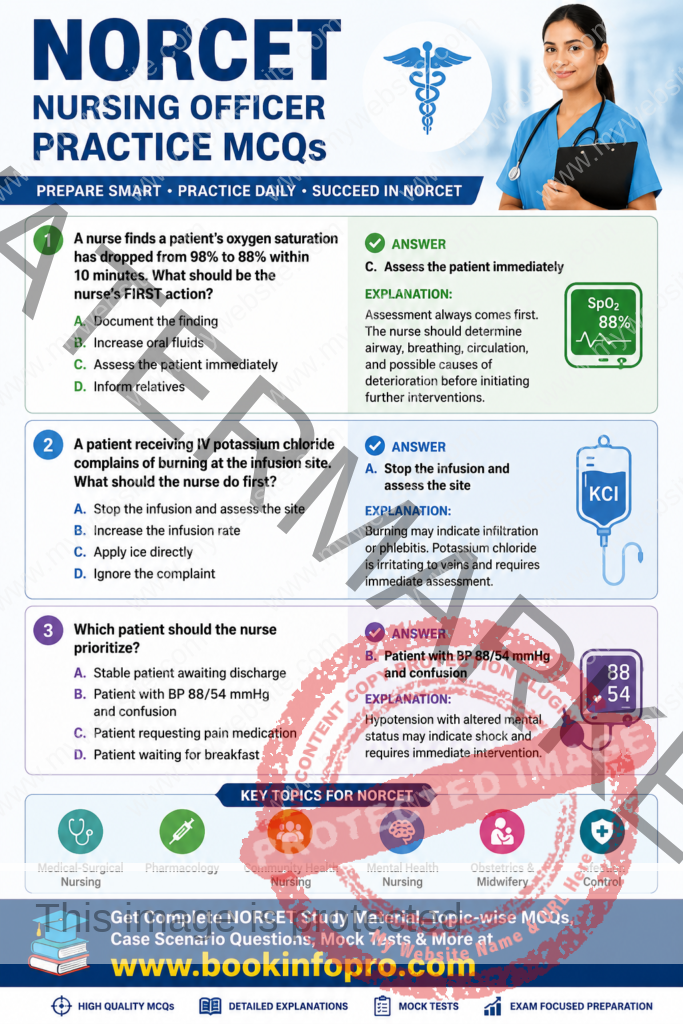
1. A nurse finds a patient’s oxygen saturation has dropped from 98% to 88% within 10 minutes. What should be the nurse’s FIRST action?
A. Document the finding
B. Increase oral fluids
C. Assess the patient immediately
D. Inform relatives
✅ Answer: C. Assess the patient immediately
Explanation: Assessment always comes first. The nurse should determine airway, breathing, circulation, and possible causes of deterioration before initiating further interventions.
2. A patient receiving IV potassium chloride complains of burning at the infusion site. What should the nurse do first?
A. Stop the infusion and assess the site
B. Increase the infusion rate
C. Apply ice directly
D. Ignore the complaint
✅ Answer: A. Stop the infusion and assess the site
Explanation: Burning may indicate infiltration or phlebitis. Potassium chloride is irritating to veins and requires immediate assessment.
3. Which patient should the nurse prioritize?
A. Stable patient awaiting discharge
B. Patient with BP 88/54 mmHg and confusion
C. Patient requesting pain medication
D. Patient waiting for breakfast
✅ Answer: B. Patient with BP 88/54 mmHg and confusion
Explanation: Hypotension with altered mental status may indicate shock and requires immediate intervention.
4. A nurse is preparing to administer insulin. Which action follows safe medication administration principles?
A. Verify the medication with another nurse if required
B. Skip patient identification if familiar with patient
C. Administer without checking blood glucose
D. Ask the patient to self-calculate dose
✅ Answer: A. Verify the medication with another nurse if required
Explanation: High-alert medications such as insulin often require independent double-checking according to institutional policy.
5. Which infection control measure is MOST effective in preventing healthcare-associated infections?
A. Wearing gloves at all times
B. Hand hygiene before and after patient contact
C. Daily room cleaning only
D. Using antibiotics routinely
✅ Answer: B. Hand hygiene before and after patient contact
Explanation: Proper hand hygiene is the single most effective method of preventing infection transmission.
6. A postoperative patient suddenly develops shortness of breath, chest pain, and tachycardia. Which condition should the nurse suspect first?
A. Constipation
B. Pulmonary embolism
C. Gastritis
D. Migraine
✅ Answer: B. Pulmonary embolism
Explanation: Sudden dyspnea, chest pain, and tachycardia after surgery are classic signs of pulmonary embolism.
7. A patient with diabetes has a blood glucose level of 52 mg/dL and is conscious. What should the nurse do first?
A. Administer IV insulin
B. Give 15–20 g of fast-acting carbohydrate
C. Restrict oral intake
D. Call security
✅ Answer: B. Give 15–20 g of fast-acting carbohydrate
Explanation: Conscious patients with hypoglycemia should receive fast-acting carbohydrates immediately.
8. Which finding indicates improvement in a patient with heart failure?
A. Increased edema
B. Weight gain of 2 kg in one day
C. Reduced shortness of breath
D. Elevated jugular venous pressure
✅ Answer: C. Reduced shortness of breath
Explanation: Decreased dyspnea suggests improved cardiac function and fluid balance.
9. A nurse observes a colleague preparing to administer medication to the wrong patient. What is the MOST appropriate action?
A. Ignore the situation
B. Report after the shift only
C. Intervene immediately to prevent the error
D. Wait for physician instructions
✅ Answer: C. Intervene immediately to prevent the error
Explanation: Patient safety is the priority. Immediate intervention can prevent harm.
10. A patient with suspected stroke suddenly develops difficulty speaking and weakness of the right arm. What should the nurse do first?
A. Document findings later
B. Activate emergency stroke protocol
C. Encourage sleep
D. Offer oral fluids
✅ Answer: B. Activate emergency stroke protocol
Explanation: Stroke is a medical emergency. Rapid recognition and activation of stroke pathways improve outcomes.
Best Preparation Strategy for NORCET
1. Build Strong Fundamentals
Master nursing concepts before attempting advanced MCQs.
2. Study Topic-Wise
Divide preparation into:
- Nursing Foundation
- Medical Surgical Nursing
- Pharmacology
- Community Health Nursing
- Mental Health Nursing
3. Practice Case Scenario Questions
Modern nursing recruitment examinations increasingly emphasize:
- Clinical judgment
- Decision-making
- Prioritization
- Patient safety
Case-based practice significantly improves performance.
4. Solve MCQs Daily
Benefits include:
- Better retention
- Faster recall
- Improved accuracy
- Enhanced confidence
5. Revise Frequently
Repeated revision is essential for:
- Drug classifications
- Nursing procedures
- Emergency protocols
- Infection control guidelines
Common Mistakes Made by Candidates
Many candidates lose marks because of:
- Inadequate revision
- Poor time management
- Weak pharmacology preparation
- Lack of practice with scenario-based questions
- Ignoring nursing fundamentals
Avoiding these mistakes can substantially improve examination performance.
Career Opportunities After NORCET
Successful candidates may work in various healthcare settings, including:
- Medical wards
- Surgical wards
- Intensive Care Units
- Emergency Departments
- Operation Theatres
- Specialty Clinics
- Community Health Services
These roles provide opportunities for professional growth and advanced nursing practice.
Frequently Asked Questions
Is NORCET difficult?
NORCET is competitive but achievable with systematic preparation and consistent practice.
Which subject is most important?
Medical-Surgical Nursing, Nursing Foundation, Pharmacology, and Community Health Nursing usually contribute significantly to nursing-related questions.
Are clinical scenario questions important?
Yes. Clinical judgment and patient-care scenarios are highly important for assessing nursing competency.
How can I improve my score?
Focus on:
- Topic-wise revision
- Daily MCQ practice
- Case-based questions
- Nursing procedures
- Medication safety concepts
NORCET Study Material and Practice Questions
For comprehensive preparation, candidates should use:
- Topic-wise nursing notes
- High-yield MCQs
- Clinical scenario-based questions
- Mock tests
- Detailed answer explanations
- Nursing procedure guides
Get NORCET Nursing Officer Study Material, Practice MCQs, Mock Tests, and Case Scenario Questions at www.bookinfopro.com
This resource can help nursing aspirants strengthen their nursing knowledge, improve clinical reasoning, and prepare effectively for Nursing Officer recruitment examinations.